mono-color
Generate original one-ink or controlled two-ink editorial images from any theme, sentence, article idea, object, or reference photo. Always use this skill when the user asks for 单色海报、双色印刷、单色调视觉、蓝色/绿色孔版印刷、risograph、网点照片、复古或当代编辑排版、zine poster, monochrome editorial poster, duotone print, or asks to use the mono-color style. It uses an adaptive white, gray, or pale-beige substrate, no more than two printing inks, active negative space, terse human language, and strong serif/grotesk/mono typography without making retro styling the default or copying a source composition, wording, logo, or artwork. Produce both the final generation prompt and the generated raster image unless the user explicitly asks for prompt only.
yanliudesign · 已有 AI 审核记录
安装与使用
运行命令前先阅读来源与依赖说明。复制命令不会自动安装或执行。
npx skills add yanliudesign/mono-color-skill --skill mono-color技能说明
name: mono-color description: Generate original one-ink or controlled two-ink editorial images from any theme, sentence, article idea, object, or reference photo. Always use this skill when the user asks for 单色海报、双色印刷、单色调视觉、蓝色/绿色孔版印刷、risograph、网点照片、复古或当代编辑排版、zine poster, monochrome editorial poster, duotone print, or asks to use the mono-color style. It uses an adaptive white, gray, or pale-beige substrate, no more than two printing inks, active negative space, terse human language, and strong serif/grotesk/mono typography without making retro styling the default or copying a source composition, wording, logo, or artwork. Produce both the final generation prompt and the generated raster image unless the user explicitly asks for prompt only.
Monocolor Editorial Print
Turn any user theme or image into an original printed editorial artifact with one stable visual language:
adaptive neutral substrate + one or two inks + reproduced image + typographic tension + concise human voice
Do not imitate any one reference. Recombine the system below into a new composition every time.
Default Deliverable
Create:
- one final image-generation prompt;
- one generated raster image;
- a short recipe note naming palette, layout family, type pairing, and print process.
Save generated files under ~/Desktop/Claude skills/mono-color/ when a file path is available. Create the folder if needed. Stop at prompt-only only when the user explicitly asks for it or no image-generation capability is available.
Input Reading
Extract four things before composing:
- Subject: the one person, object, scene, or idea that must remain recognizable.
- Intent: poetic observation, announcement, field note, personal statement, cultural poster, or specimen page.
- Words: preserve exact supplied text in its original language. When no text is supplied, invent one English display phrase of 2-8 words and preserve it across retries. Omit display text only when the user explicitly requests a text-free image.
- Image role: hero photograph, isolated specimen, cropped fragment, texture source, or no supplied image.
- Representation: faithful reproduction or abstract symbol extraction. Choose abstract symbol extraction when the user asks for abstract, artistic, loose, experimental, less realistic, or less photographic treatment.
For a complex topic, choose one concrete visual metaphor. Do not illustrate every point.
When the user supplies an image, preserve its identity and core factual content. In faithful reproduction, crop, isolate, enlarge, simplify, or convert it to halftone. In abstract symbol extraction, preserve 2-4 identifying anchors while replacing photographic description with simplified masses, contours, repeated marks, and exposed paper. Never replace the subject or invent branded details.
Recipe Manifest
Before writing the generation prompt, resolve the input into this manifest. Do not skip fields and do not expose the manifest unless the user asks for process details.
Use the machine-readable catalogs in design-system/ as the source of truth for palette IDs, typography roles, composition geometry, carrier signals, visual rhythm, and controlled print imperfections. Read only the relevant catalog for the current decision. The prose below explains intent; when an exact value differs, the catalog wins.
subject: <one recognizable subject>
intent: <one intent from Input Reading>
exact_text: <user text, generated 2-8 word phrase, or none>
text_language: <language of supplied text, otherwise English>
representation: <faithful reproduction or abstract symbol extraction>
ratio: <explicit ratio or 3:4>
carrier: <one carrier ID from design-system/carriers.json or none>
substrate: <one substrate ID and exact hex from design-system/colors.json>
mode: <pure one-ink, chromatic + black, complementary duotone, or overprint duotone>
palette: <one palette ID from design-system/colors.json>
inks: <the palette's named ink or approved pair with exact hex values>
plate_roles: <one explicit role per ink plate>
layout: <one composition ID from design-system/compositions.json>
empty_paper: <explicit percentage>
visual_tension: <relaxed, balanced, or assertive from design-system/rhythm.json>
focal_event: <one strong visual event from design-system/rhythm.json>
release_zone: <one deliberately quiet region that gives the focal event room>
unresolved_edge: <one optional edge behavior from design-system/rhythm.json or none>
image_treatment: <one mechanical reproduction process>
type_hierarchy: <one role ID from design-system/typography.json>
disruption: <one deliberate disruption>
imperfection_seed: <stable hash derived from the resolved recipe>
imperfections: <0-2 restrained effect IDs for contemporary work, or 2-3 for tactile/vintage work>
Use these defaults whenever the user has not made the choice:
- ratio:
3:4; - representation:
faithful reproduction, unless the user asks for abstract, artistic, loose, experimental, less realistic, or less photographic treatment; - text language: English for all invented display text, labels, and microcopy;
- substrate: select from Neutral White
#FAFAF7, Cool Gray#E9E9E5, or Pale Beige#F5F1E8according to the subject, image values, and ink contrast. Neutral White is the unspecified default; never assume beige or aged paper merely because the work uses halftone or risograph language; - mode and ink: controlled two-ink by default. Use Cobalt + Terracotta
#2148B8+#C65F38for an unspecified subject, then select the closest approved pair for the subject. The dominant plate carries 70%-85% and the accent plate carries 15%-30%. Switch to pure one-ink only when the user explicitly requests one ink, monochrome, or one named ink without a second color; - empty paper:
35%; - visual tension:
relaxedfor reflective, travel, summer, leisure, lifestyle, and unspecified cultural subjects;balancedfor ordinary events and editorial info
先看看实际效果
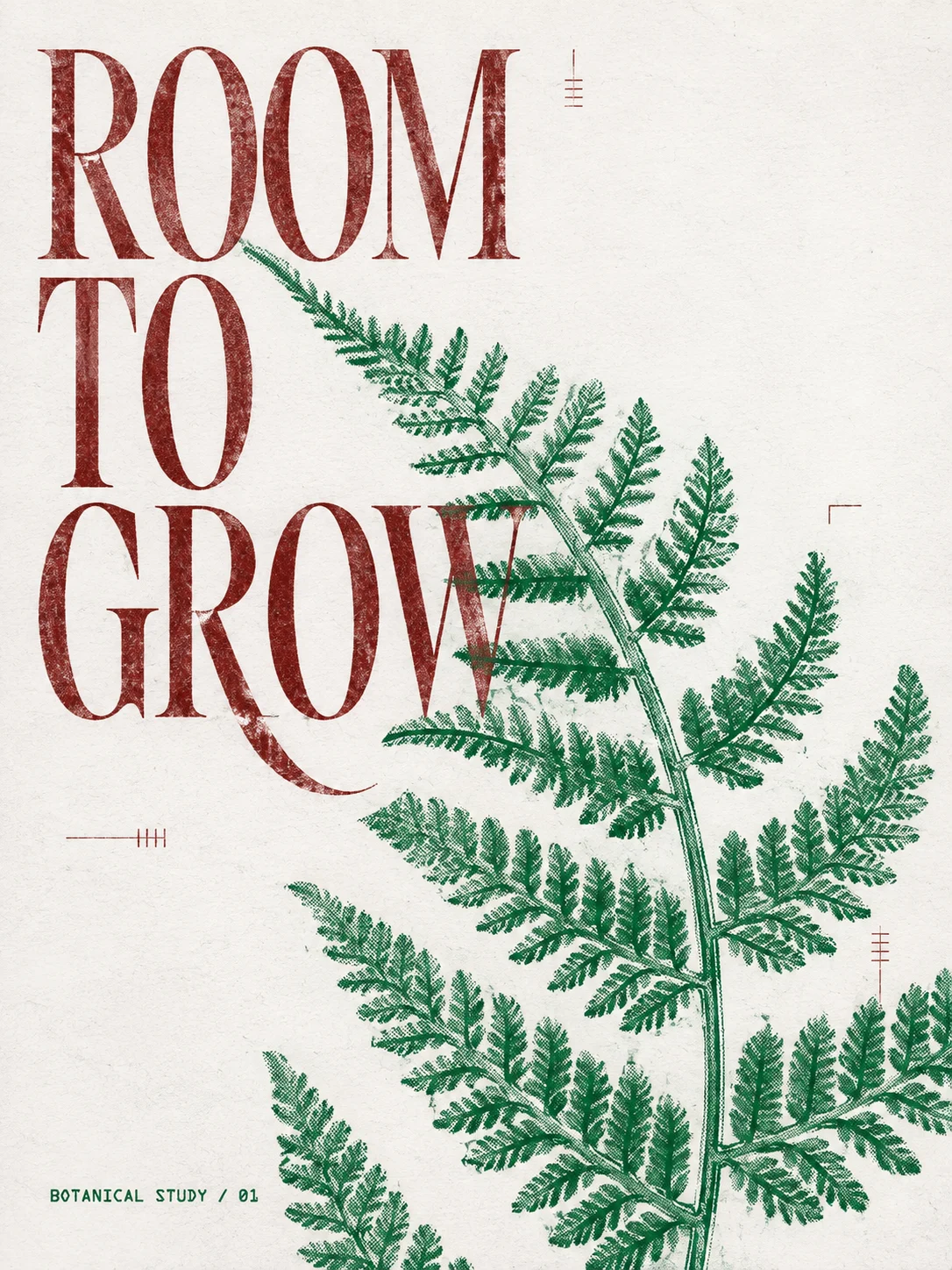
留一点生长空间
本站制作 · OpenAgentSkill 于 2026 年 9 月 7 日,参考本地安装的 mono-color 方法,用 Codex 图像生成工具制作。单次生成,未人工修图;服务未返回底层模型名称或单张费用。这是一次制作记录,不代表跨 Agent 测试。