ip-as-logo
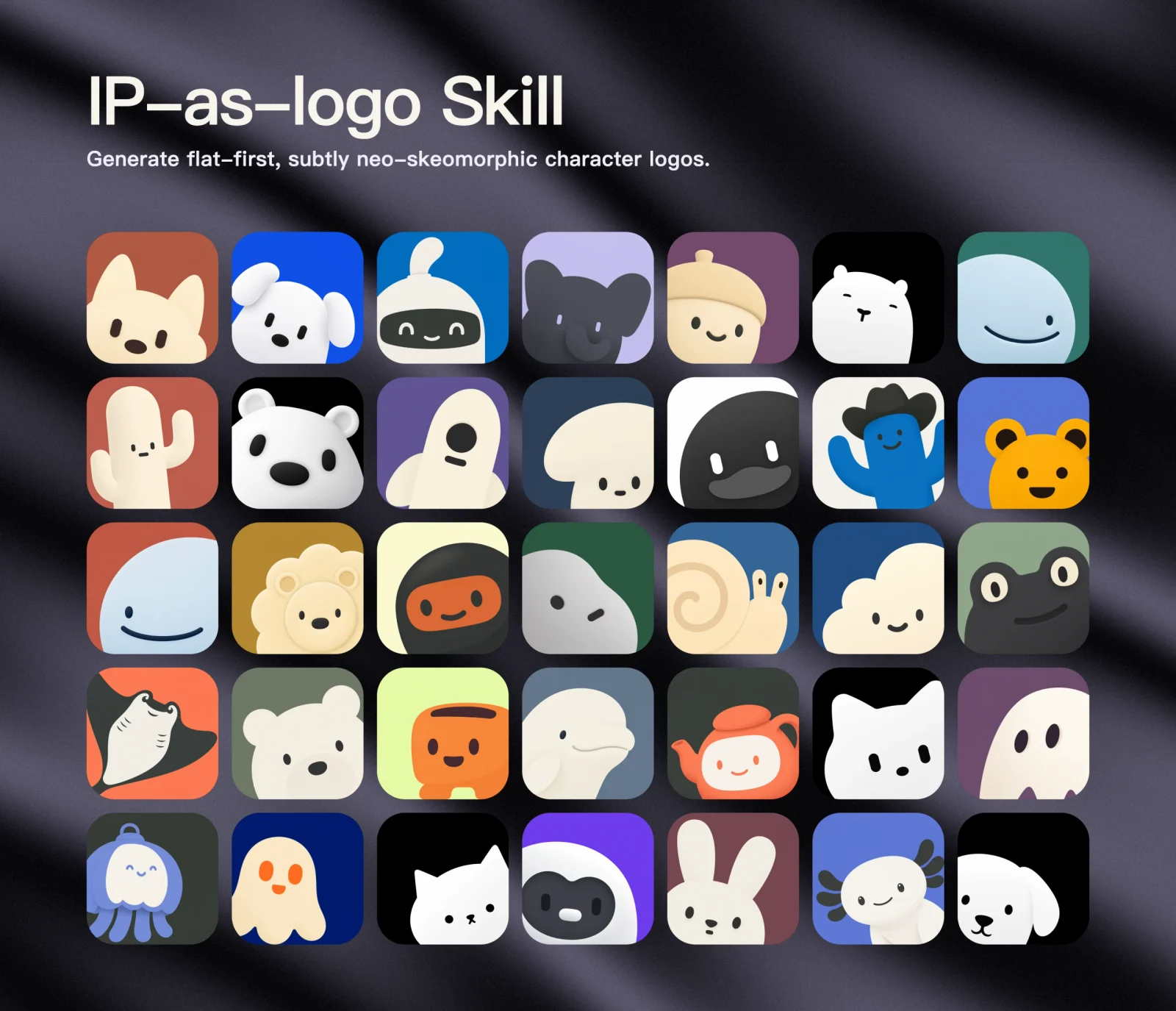
Generate highly simplified personified IP mascot logos with Flat-first geometry, rounded heavy forms, two IP colors plus one background color by default, and extremely subtle neo-skeuomorphic shading. Use when creating an animal, creature, robot, ghost, plant, object, or other character as a minimal square logo or app-icon artwork, including when the agent should infer three distinct IP directions from product-repository context.
s1dashu · 已有 AI 审核记录
安装与使用
运行命令前先阅读来源与依赖说明。复制命令不会自动安装或执行。
npx skills add s1dashu/ip-as-logo-skill --skill ip-as-logo技能说明
name: ip-as-logo description: Generate highly simplified personified IP mascot logos with Flat-first geometry, rounded heavy forms, two purposeful IP colors over one solid background color, and ultra-light neo-skeuomorphic internal modeling. Use when creating an animal, creature, robot, ghost, plant, object, or other character as a minimal square logo or app-icon artwork, including when the agent should infer three product-relevant directions and propose six independent candidates for approval.
IP as Logo
Create a logo first and a character second. Reduce the subject to a compact symbol that remains recognizable at 32 × 32; do not produce a character illustration.
Workflow
- Parse the request for an explicit IP subject and available product context. Do not ask the user to choose a color mode unless they explicitly want to control it.
- When the user has not specified an IP subject and the current workspace is a product repository, inspect relevant read-only context before asking questions. Prefer the README, product docs, package or app metadata, landing-page copy, manifests, and design tokens. Treat context as sufficient when the product purpose, primary audience, and intended personality can be inferred with reasonable confidence.
- When product context is insufficient, ask one consolidated round of background questions covering what the product does, who it serves, and how it should feel. Do not start a second background questionnaire. Continue with the best supported interpretation after the answer.
- Once context is sufficient, always present three concise directions before generation and explicitly propose generating six independent logo candidates in one batch. Do not generate until the user agrees, unless the current request already explicitly authorizes six outputs or asks the agent to proceed without another confirmation.
- Choose the three proposed directions deliberately:
- When the user explicitly specifies an IP subject, keep that subject and propose three distinct design treatments based on composition, silhouette treatment, secondary color region, or personality emphasis.
- When the user does not specify an IP subject, propose three genuinely different IP subjects or metaphors. Tie each one to a different product attribute or brand promise; do not return three arbitrary animals with no rationale.
- Interpret the user's response exactly:
- If the user accepts all three directions and the six-image proposal, generate two independent variants per direction and label them
A1,A2,B1,B2,C1, andC2. - If the user selects one direction but accepts six images, generate six controlled variants of that direction and label them
A1throughA6. - If the user rejects the proposed quantity, directions, or distribution, follow the user's replacement instructions without arguing for the default.
- If the user accepts all three directions and the six-image proposal, generate two independent variants per direction and label them
- Default every candidate to exactly three semantic colors in the complete artwork: exactly two IP base colors plus exactly one background color. Reuse the two IP colors for facial marks and internal modeling rather than introducing additional semantic colors. Follow an explicit user request for another color count. Keep required product cues, identifying features, complexity limits, and any supplied palette consistent enough for useful comparison.
- Determine the available image-generation path before promising output. In Codex, use ImageGen when it is available. In any other agent environment, use an available configured image generator; if none is available, ask the user whether they can provide or enable one. Do not fabricate generated results.
- If the runtime supports subagents, parallelize the six independent candidates up to the available concurrency. Give every subagent the same product brief, shared constraints, and one assigned direction or variant; run remaining candidates in subsequent waves when capacity is limited. If subagents are unavailable, generate the candidates through separate image-generation calls or jobs.
- If the user supplies a background palette, reserve every supplied color for backgrounds unless they explicitly say otherwise. Choose exactly two IP base colors independently for the subject and context unless the user also assigns subject colors. Do not treat any historical or example palette as a closed list of allowed backgrounds.
- Abstract each subject using the complexity budget below. Generate every candidate as a separate full-resolution square asset; never ask an image model to compose a contact sheet, grid, or multi-logo image. Do not use existing logos or sibling candidates as image references when testing prompt-only reproducibility.
- Inspect every output against every evaluation rule. Retry with one targeted correction when practical; never hide a failed constraint with silent post-processing. Treat a transparent or absent background as an allowed output variation unless the user explicitly requires an opaque background.
- Preserve and label every generated result, whether its background is opaque or transparent. Report every label, IP direction and rationale, saved path, prompt/color mapping, dimensions, background mode, and remaining deviations. Present all results together and ask which candidate the user wants to refine.
When proposing directions before generation, describe each in one compact line: <IP subject> — <product connection> — <defining silhouette>. End with a direct proposal to generate six images using the distribution above. Do not turn the discovery phase into a long branding workshop unless the user asks for one.
Complexity budget
- Build one dominant continuous outer silhouette from roughly
6–10basic geometric shapes. - Use at most one species-defining feature: for example, one large pouch beak, one pair of curled horns, or one broad visor.
- Use at most two broad internal color regions corresponding to the two IP base colors. Keep the face to two eyes and o
先看看实际效果
小角色,大辨识度
作者风格示例 · 于 2026-09-08 从作者仓库的固定版本中精选。保留原图,展示副本仅缩放压缩。本站检查了预览,没有重新运行技能;未核实原始提示词、模型、制作时长与成本。示例数字及科学标注需独立核查。